Kitchen - under $50
Best Electric Kettle Under $50
Every kettle in this price band boils water. What separates them is what the water touches on the way.
By Brijon M. - Published October 17, 2026
The short answer
The Cosori gooseneck electric kettle is the best buy under $50 if you make pour-over coffee or tea that needs a specific temperature - it has a stainless water path, preset temperatures and a controlled pour. If you only want fast hot water, a stainless-interior fast-boil kettle does the same job for less and lasts just as long.
Disclosure: we earn commission on qualifying purchases made through the links below, at no extra cost to you. It never changes the order of our picks - here is how that works.
The three things that actually matter under $50
Electric kettles are a solved problem. A $20 kettle and a $200 kettle both bring a litre of water to a boil in roughly the same time, because both are limited by the same thing - how many watts a domestic outlet will give them. Wattage is therefore close to a non-decision.
What the water touches. This is the real spec. A fully stainless or glass water path means hot water never sits against plastic. Many cheap kettles have a stainless interior wall but a plastic lid, plastic filter and plastic spout insert, which is where the new-kettle taste comes from. If a kettle's listing is vague about the interior, assume plastic.
Whether you can clean it. A kettle is a scale factory. A wide lid opening you can get a hand and a cloth into is the difference between a kettle you descale and a kettle you replace. Narrow-necked gooseneck kettles are the worst offenders here - a real trade-off for the pouring control they buy you.
Variable temperature, if and only if you need it. Green tea at 175°F and pour-over coffee at 200°F are genuinely different from boiling, and a kettle that holds a temperature is worth the money for those. For tea bags, instant noodles and a hot water bottle, boiling is boiling and temperature control is a feature you will use once.
- Stainless or glass water path. Hot water against plastic is the one spec worth paying for.
- Wide lid opening - you will descale this thing monthly if your water is hard.
- Variable temperature only for pour-over and loose-leaf tea.
- Auto shut-off and boil-dry protection are non-negotiable. Every pick here has both.
Gooseneck or regular?
A gooseneck is a narrow, curved spout that delivers a slow, aimable stream. It exists for one reason: pour-over coffee, where the rate and placement of the water over the grounds changes the extraction.
If you make pour-over, a gooseneck is close to required equipment and the cheapest route to a noticeably better cup. If you do not, it is a worse kettle - slower to fill, slower to pour into a mug, and much harder to clean inside.
The middle option is a regular kettle with a well-shaped spout and variable temperature. For loose-leaf tea, that is plenty: you want the right temperature, not a controlled spiral.
There is no gooseneck-versus-regular performance argument about boiling. Both boil the same water in the same time, and the choice is entirely about what you are pouring it onto.
Quick picks
The short version. Tap any row to jump to the full write-up, or go straight to Amazon to check the current price.
| # | Product | Best for | Price |
|---|---|---|---|
| 1 | Cosori electric gooseneck kettle Preset temperatures, a stainless water path and real pour control at half the price of the name brands. | Best overall | |
| 2 | A 1.7L stainless-interior fast-boil kettle Boils fast, holds enough for a pot and a hot water bottle, and has nothing to go wrong. | Best for most kitchens | |
| 3 | A glass variable-temperature kettle Temperature presets for every tea type, and you can see the scale before it gets bad. | Best for tea | |
| 4 | A 0.5L compact travel kettle Boils one mug fast, stores in a drawer, and costs almost nothing to run. | Best for one person or a small space | |
| 5 | Hamilton Beach stainless electric kettle A plain, fast, stainless kettle from a company with spare parts and a warranty. | Cheapest from a known brand |
We do not print prices on this site. Every button opens the live Amazon listing so you see the real price at the moment you click. See our affiliate disclosure.
1. Best overall
Cosori electric gooseneck kettle
Preset temperatures, a stainless water path and real pour control at half the price of the name brands.
- 0.8 litre capacity
- Variable temperature with presets, hold function
- Gooseneck spout
- Stainless steel interior
Specialty-coffee reviewers keep landing on this kettle for the same reason: it does what the premium gooseneck kettles do, at roughly half their price, and the temperature presets land where they claim to.
The hold function is the feature worth having. It keeps the water at your chosen temperature for an hour, which matters for a second cup and for tea that you brew in stages.
The pour is the point. A gooseneck gives you a slow, placeable stream, and for pour-over that is the single biggest equipment upgrade available under fifty dollars.
What you give up
The small capacity is limiting if you also want the kettle for pasta water or a hot water bottle, and the narrow neck makes descaling genuinely awkward - plan on citric acid rather than a sponge.
2. Best for most kitchens
A 1.7L stainless-interior fast-boil kettle
Boils fast, holds enough for a pot and a hot water bottle, and has nothing to go wrong.
- 1.7 litre capacity
- Stainless steel interior
- Cordless base, 360-degree pour
- Auto shut-off and boil-dry protection
For the large majority of households this is the correct purchase. It boils a full litre and a half for a teapot, it refills a hot water bottle, and it costs noticeably less than anything with a digital display.
The spec that matters is the stainless interior. The cheapest kettles on the shelf have a plastic water path, which is where the taste complaint comes from on day one and the staining comes from on day one hundred.
There is also a reliability argument for the simple version: no PCB, no display, no temperature probe. A mechanical kettle with a bimetallic switch fails in one way, after a long time.
What you give up
No temperature control at all, so green tea gets stewed unless you boil and wait. Check the lid opening before you buy - some models in this class have an opening too narrow to get a hand into.
3. Best for tea
A glass variable-temperature kettle
Temperature presets for every tea type, and you can see the scale before it gets bad.
- 1.7 litre glass body
- Multiple temperature presets
- Keep-warm function on most models
- Some ship with a removable tea infuser
If you drink green, white or oolong tea, boiling water is actively wrong - it scalds the leaf and the result is bitter. A preset kettle fixes that for about the price of a takeaway lunch.
Glass has a real practical advantage beyond looks: you can see limescale building and descale before it is a layer. On a steel kettle you find out when the water tastes odd.
The models that include an infuser basket are a genuinely good deal for loose-leaf drinkers - that is a separate purchase otherwise.
What you give up
Glass is breakable, it shows every fingerprint and water mark, and the base and lid are still plastic on almost every model at this price. Keep-warm running for hours uses meaningfully more electricity than reboiling.
4. Best for one person or a small space
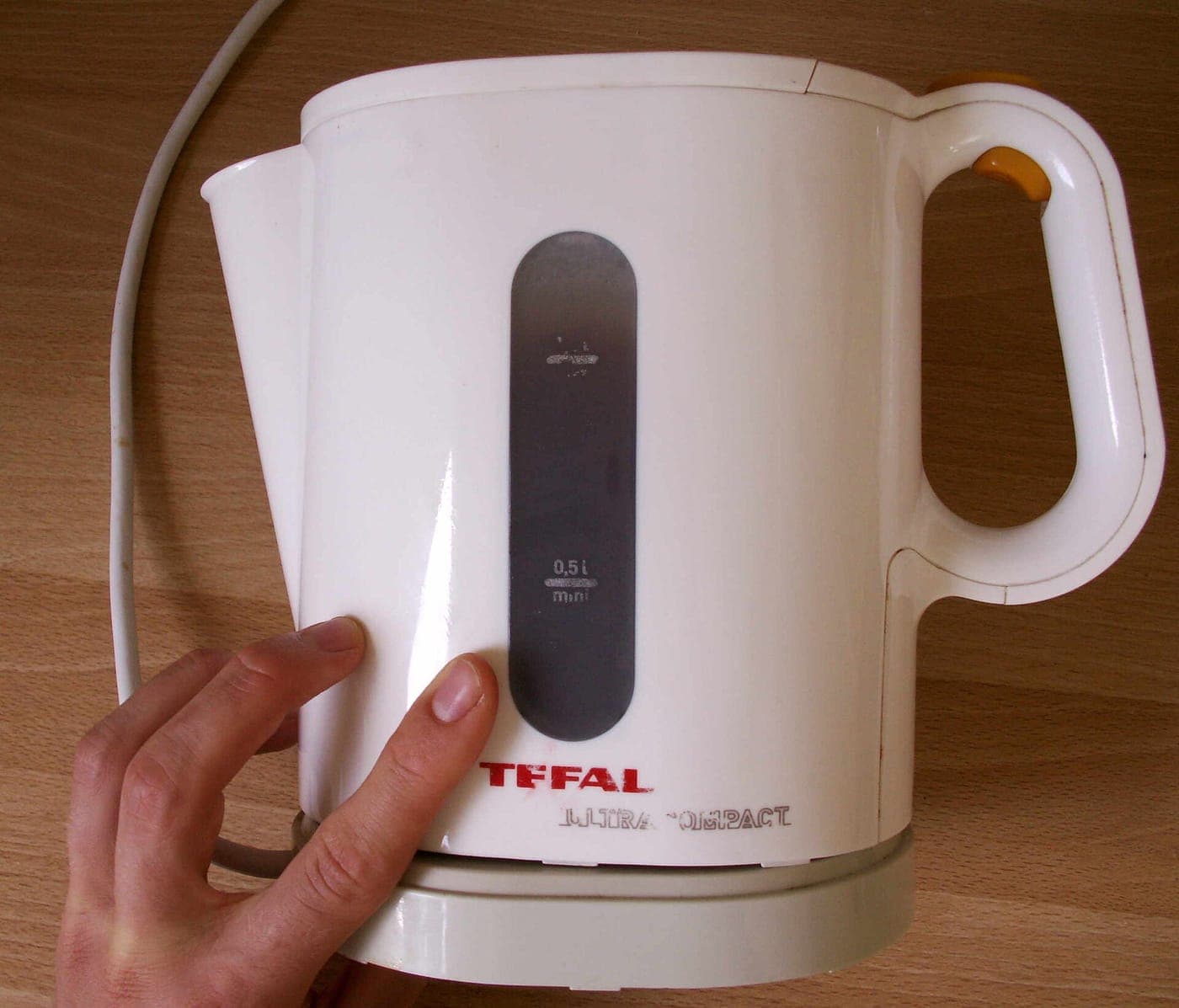
A 0.5L compact travel kettle
Boils one mug fast, stores in a drawer, and costs almost nothing to run.
- 0.5-0.8 litre capacity
- Small footprint
- Boils a single mug in roughly two minutes
- Auto shut-off
A dorm room, an office, a small apartment or a hotel - this is the right size for one person who makes one drink at a time, and it boils a mug's worth faster than a full-size kettle because there is less water to heat.
It is also the efficient choice if you habitually boil far more water than you use, which most people do. Heating half a litre you will pour away is the largest avoidable waste in this entire category.
Check for a stainless interior here too. The travel tier is where plastic water paths are most common.
What you give up
Too small for a teapot, a saucepan of pasta or a hot water bottle, so for many households it has to be a second kettle rather than the only one.
5. Cheapest from a known brand
Hamilton Beach stainless electric kettle
A plain, fast, stainless kettle from a company with spare parts and a warranty.
- 1.7 litre capacity
- Stainless body and interior
- Cordless base with cord storage
- Auto shut-off and boil-dry protection
The bottom of the market is full of brands that will not exist in three years. Hamilton Beach has made kitchen appliances for a very long time, has a warranty department, and sells into stores that take returns.
That matters more than it sounds on a product that lives on a worktop and gets used several times a day. A kettle is a small purchase with a high duty cycle.
Features are deliberately minimal - boil, shut off, pour. For a lot of kitchens that is the complete list.
What you give up
No temperature control and a basic lid that some owners find stiff. A stainless exterior also gets hot, which is worth knowing in a house with small children.
Limescale is the thing that kills kettles
Not the element, not the switch - scale. In a hard-water area a kettle furs up within weeks, and scale insulates the element so the kettle takes longer, uses more electricity and eventually fails.
Descale monthly in hard water, quarterly in soft. White vinegar or citric acid, half-fill, boil, leave for an hour, rinse twice. Citric acid leaves less of a smell and is what we would use.
Do not leave water standing in it. Water left overnight both deposits scale and concentrates whatever was dissolved in it. Boil what you need and tip the rest.
Replace the mesh filter rather than fighting it. The spout filter catches flakes of scale, and once it is clogged, the pour is bad and the flakes go in the cup anyway.
If the kettle furs up fast, that is also your warning about the rest of the kitchen - the same water is going into your coffee maker. Our best coffee maker under $100 picks note which machines have a descale cycle and which do not.
Does a kettle save money over the stove?
Marginally, and the reason is efficiency rather than price. An electric kettle puts nearly all its energy into the water because the element sits in it. A stovetop kettle on a gas or electric hob loses a lot of its heat to the air around the pan.
The far bigger saving is behavioral: boil only what you need. Filling a 1.7 litre kettle to make one mug of tea wastes roughly four-fifths of the energy, every time, and this is by a wide margin the biggest lever in the category. Most kettles have minimum and maximum marks on the window for exactly this reason.
That is also an argument for the small kettle in the list above if you live alone. You physically cannot over-fill a half-litre kettle by much.
What a kettle will not do is make you money back on a replacement. If your current kettle works, keeping it is cheaper than any efficiency gain from a new one.
What we would actually buy
Pour-over coffee: the Cosori gooseneck. Temperature presets and a controlled stream are the two things that change the cup, and no other sub-$50 purchase in a coffee setup does more.
Tea, mixed types: a glass variable-temperature kettle. Green tea at boiling point is the most common avoidable mistake in a tea cupboard.
Everything else: a 1.7 litre stainless-interior fast-boil kettle. It is cheaper, it holds more, and there is less of it to break.
If you are putting a coffee setup together from the start, cheap espresso machine buying guide covers the next decision up, and best coffee maker under $100 covers the drip route.
How we picked
Every pick on this page is a real, currently-sold product that we could find at or under $50 at the time of the last update. Rank order is set before any link is attached.
We are research-led, not lab-led. We do not run a test lab and we do not claim to have personally used every product on this site. Picks come from manufacturer specifications, owner-reported reliability and failure patterns, expert-publication consensus, and real availability at the stated price ceiling. Read the full method.
Common questions
+What is the best electric kettle under $50?
The Cosori gooseneck kettle if you make pour-over coffee or temperature-sensitive tea - it has a stainless water path, accurate presets and a hold function. For general kitchen use a 1.7 litre stainless-interior fast-boil kettle is the better buy: more capacity, less to break, and less money.
+Do I need a variable temperature kettle?
Only for pour-over coffee and for green, white or oolong tea, where boiling water scalds the leaf and tastes bitter. For tea bags, instant drinks and hot water bottles, boiling is boiling and temperature control is a feature you will use once.
+Are plastic electric kettles safe?
Kettles sold in the US use food-contact-rated plastics, but a stainless or glass water path avoids the question entirely and avoids the new-kettle taste that plastic interiors are known for. Note that many kettles with a stainless interior wall still have a plastic lid, filter and spout insert.
+Is a gooseneck kettle worth it?
For pour-over coffee, yes - the slow aimable stream is the cheapest meaningful upgrade to the brew. For anything else it is a worse kettle: smaller, slower to pour into a mug, and much harder to descale because of the narrow neck.
+How often should I descale an electric kettle?
Monthly in a hard-water area, quarterly in a soft-water one. Half-fill with white vinegar or citric acid solution, boil, leave an hour, then rinse twice. Scale insulates the element, so a furred-up kettle is slower and costs more to run before it eventually fails.
+Is an electric kettle cheaper to run than boiling on the stove?
Slightly, because the element sits in the water rather than heating the air around a pan. The much bigger saving is only boiling what you need - filling a 1.7 litre kettle for one mug wastes roughly four-fifths of the energy every single time.
Sources
Read next

Best coffee maker under $100
Best Coffee Maker Under $100 (October 2026)
Brew temperature explains almost everything. Five coffee makers under $100, including one that costs $25.
Kitchen
Cheap Espresso Machine Buying Guide
Why cheap espresso machines plateau, what the grinder actually does, and the honest entry price.
Best rice cooker under $50
Best Rice Cooker Under $50 (October 2026)
A thermostat and a switch, and it works. Five rice cookers under $50 and what fuzzy logic really adds.
Category
Kitchen
Air fryers, blenders, knives and coffee gear - the categories where spending more buys the least.
Shop by price
Under $50
The impulse tier. Some categories are genuinely solved at $50; others are a false economy, and we say which.
Think we got a pick wrong, or spotted one that is out of stock or over its ceiling? Tell us - corrections go to the front of the queue.