Kitchen
What Knives Do Chefs Recommend? Three, and They Are Cheap
The knife a professional cook reaches for costs less than most people spend on a single block-set steak knife. There is a good reason for that.
By Brijon M. - Published October 5, 2026
The short answer
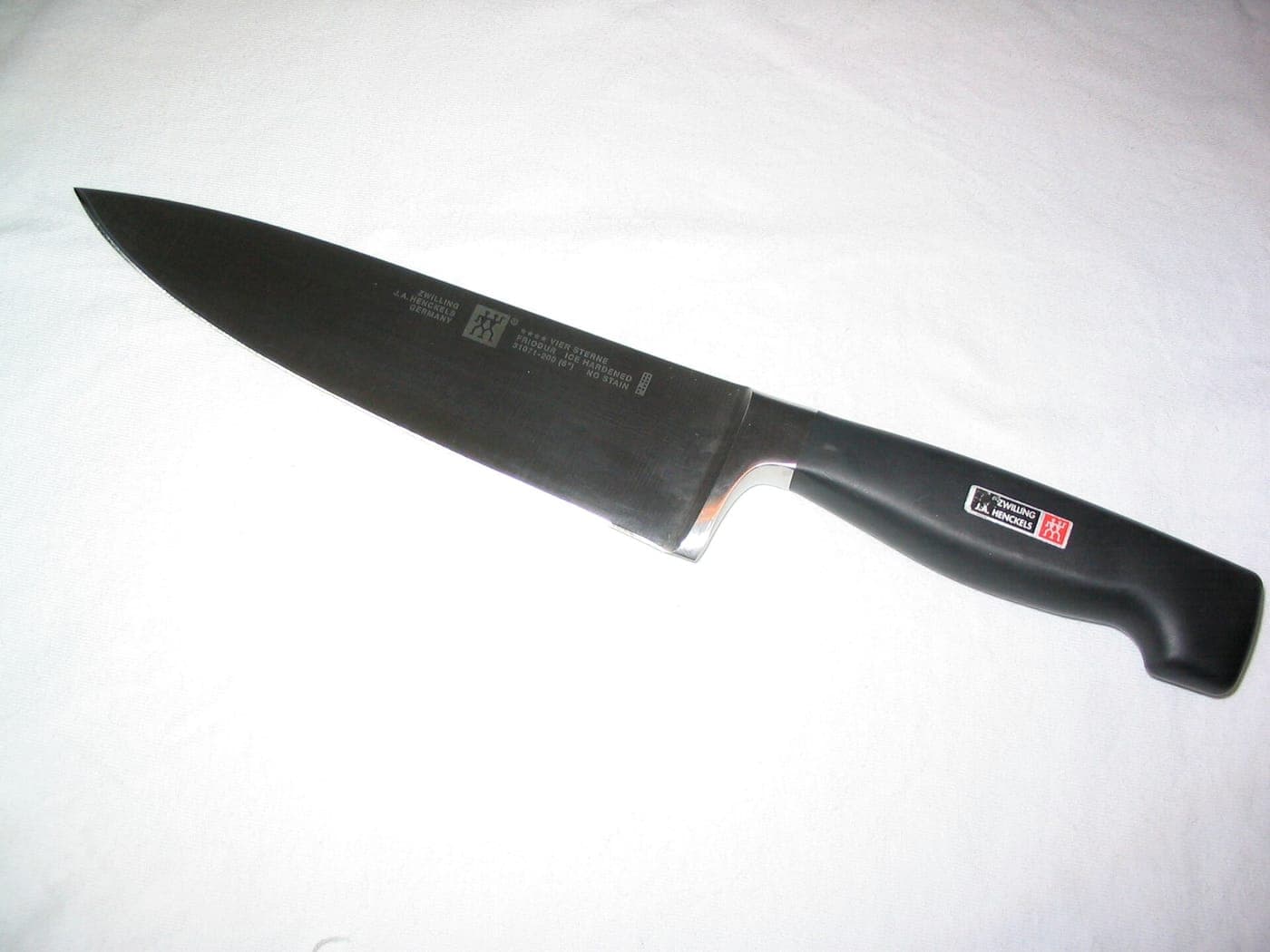
Chefs recommend three knives: an **8-inch chef's knife**, a **paring knife** and a **serrated bread knife**. The chef's knife does roughly 90% of the work. The usual professional recommendation is the Victorinox Fibrox Pro or the Mercer Millennia - both inexpensive, both soft enough to sharpen easily, both NSF-rated for commercial kitchens.
Three knives do everything
A professional kitchen is not short of money, and it still runs on three shapes. Understanding why kills the appeal of the fifteen-piece block permanently.
The 8-inch chef's knife. This is the knife. Chopping, slicing, dicing, mincing, breaking down a chicken, crushing garlic with the flat. It handles roughly nine tasks in ten, and it is the only knife where quality and fit to your hand genuinely matter.
The paring knife. For work done in your hand rather than on a board: hulling strawberries, peeling shallots, deveining shrimp, cutting the eye out of a potato. A chef's knife is the wrong tool for anything held in the air.
The serrated bread knife. The one job a sharp straight edge genuinely cannot do. Serrations saw through a crust without crushing the crumb, and the same action handles tomatoes and citrus skins. It also never needs sharpening in any practical sense.
Everything else in a knife block - the santoku, the utility knife, the boning knife, the five extra steak knives - is either a duplicate of the chef's knife at a different size or a specialist tool for a task most home cooks do once a year.
- 8-inch chef's knife - about 90% of all cutting.
- Paring knife - anything cut in your hand.
- Serrated bread knife - bread, tomatoes, citrus.
Why professional cooks buy cheap knives
This surprises people, and the reasoning is practical rather than frugal.
Sharpness beats steel. A cheap knife that is sharp outperforms an expensive knife that is dull, every time and by a wide margin. Since all knives dull, what matters is how often you sharpen - and that is a habit, not a purchase.
Softer steel is easier to maintain. Premium Japanese knives use hard steel that holds an edge longer but chips if you hit a bone and needs skill and good stones to re-sharpen. The softer European steel in a Victorinox or Mercer dulls faster and comes back to sharp in thirty seconds on a honing rod. In a working kitchen that trade is obviously correct.
Knives get lost, dropped and abused. A line cook's knife goes in a bag, gets borrowed, gets put through a dish pit it should not be in. Nobody wants a $250 knife in that environment.
NSF certification. The models chefs name are usually NSF-rated, which means a sealed handle with no crevices for bacteria. That is a hygiene requirement in commercial kitchens, and it happens to make them easy to clean at home.
Quick picks
The short version. Tap any row to jump to the full write-up, or go straight to Amazon to check the current price.
| # | Product | Best for | Price |
|---|---|---|---|
| 1 | Victorinox Fibrox Pro 8-inch Chef's Knife The most-recommended inexpensive chef's knife in professional kitchens, for about twenty years running. | The chef's knife to buy | |
| 2 | Mercer Culinary Millennia 8-inch Chef's Knife The knife handed to students on day one, with a grippier handle than the Victorinox. | Best alternative, and the culinary-school standard | |
| 3 | Mercer Culinary Millennia 10-inch Wide Bread Knife Few, wide, deep serrations - which is what makes a bread knife cut rather than tear. | The bread knife | |
| 4 | Victorinox Swiss Classic Paring Knife Costs almost nothing, does the in-hand work no large knife can. | The paring knife |
We do not print prices on this site. Every button opens the live Amazon listing so you see the real price at the moment you click. See our affiliate disclosure.
1. The chef's knife to buy
Victorinox Fibrox Pro 8-inch Chef's Knife
The most-recommended inexpensive chef's knife in professional kitchens, for about twenty years running.
- 8-inch stamped blade
- Textured Fibrox handle
- NSF certified
- Dishwasher safe
If one knife had to represent the whole argument on this page, it is this one. It arrives sharp, stays usable, cuts cleanly through everything a home kitchen contains, and costs less than a takeaway meal for two.
The Fibrox handle is the underrated part. It is textured plastic rather than wood, which means it does not get slippery with wet hands or raw chicken on them, and it suits large and small hands equally - the most common complaint about premium knives is that the handle fits the designer rather than you.
The blade is stamped rather than forged, which makes it light. A light knife is less tiring over an hour of prep, and the lack of a heavy bolster means you can sharpen the full length of the edge.
What you give up
It looks utilitarian and feels light, which some cooks read as cheap. The soft steel needs honing often - every few uses - to stay at its best.
2. Best alternative, and the culinary-school standard
Mercer Culinary Millennia 8-inch Chef's Knife
The knife handed to students on day one, with a grippier handle than the Victorinox.
- High-carbon stainless blade
- Santoprene and polypropylene handle
- NSF certified
- 8-inch blade
Mercer's Millennia line is what many American culinary schools put in their required kit, which is as close to a professional consensus as this category gets. It is a direct competitor to the Victorinox at a near-identical price.
The handle is the differentiator: a Santoprene grip with finger protection and a textured surface that is, if anything, more secure than the Fibrox when wet. Which you prefer is genuinely a matter of hand shape.
The blade takes a keen edge and, like the Victorinox, re-sharpens easily because the steel is not excessively hard.
What you give up
The handle's molded finger guard is divisive - it suits a standard grip and gets in the way of a pinch grip for some cooks. Finish quality is basic.
3. The bread knife
Mercer Culinary Millennia 10-inch Wide Bread Knife
Few, wide, deep serrations - which is what makes a bread knife cut rather than tear.
- 10-inch serrated blade
- Wide-set serrations
- NSF certified
- Offset-free straight handle
Bread knives are where serration design matters and almost nobody looks. Many cheap bread knives use lots of small, shallow teeth, which saw slowly and tear soft crumb. This one uses fewer, wider, deeper serrations, which bite through a hard crust in fewer strokes and leave a clean face.
Ten inches is the right length. An 8-inch bread knife cannot cross a sourdough boule in one stroke, and a multi-stroke cut is what produces a ragged slice.
It also handles tomatoes, peppers and citrus better than any straight edge you own.
What you give up
Serrated knives cannot realistically be re-sharpened at home, so this is a knife you eventually replace rather than maintain. It is a single-purpose tool.
4. The paring knife
Victorinox Swiss Classic Paring Knife
Costs almost nothing, does the in-hand work no large knife can.
- Short 3 to 4-inch blade
- Lightweight
- Dishwasher safe
- Sold singly or in pairs
Buy two. They are inexpensive enough that having a second one in the drawer removes the small daily friction of the first being dirty, and the paring knife is the one most likely to disappear into a fruit bowl.
What you want from a paring knife is lightness and a thin blade, both of which this has. It is for peeling, hulling, trimming and segmenting - work done in the air, against your thumb, where a chef's knife is dangerous and clumsy.
Victorinox's version is the same steel and the same handle philosophy as the Fibrox chef's knife, scaled down.
What you give up
The thin blade flexes under force, so this is not a knife for anything dense. The plastic handle is purely functional.
Why chefs tell you not to buy the block set
A fifteen-piece block at a given price is fifteen compromises. The money is divided across six steak knives you will use at Christmas, a santoku that duplicates the chef's knife, a utility knife that is a short chef's knife, a pair of shears, a honing rod and a lump of wood - and whatever is left over pays for the three knives you will actually use.
Buy those three individually at the same total price and each one is several times better. That is the entire argument, and it is why professional kitchens have no knife blocks.
If you want the full case on sets, including when a set is the right answer, our affordable knife set buying guide and the best knife set under $100 roundup cover it.
Keeping them sharp, which matters more than any of this
Three habits, and they cost almost nothing.
Hone before you cook. A honing rod does not remove metal, it straightens an edge that has rolled over microscopically. Eight passes per side, a few seconds, and a dull-feeling knife feels new again. Do this every couple of uses.
Sharpen a few times a year. Honing eventually stops working because the edge has genuinely worn. A cheap pull-through sharpener is fine for soft European steel; a whetstone is better if you enjoy it. Both work, and the worst option is neither.
Never put a good knife in the dishwasher, and never leave it in the sink. The models here are technically dishwasher-safe, but the detergent dulls the edge and a blade loose in a sink is how people get cut. Wash, dry, put it away.
Cut on wood or plastic. Glass, stone and ceramic boards destroy an edge in a single meal. This is the single most common way home cooks ruin a knife.
Common questions
+What knife do professional chefs actually use?
Most often an 8-inch chef's knife, and very commonly an inexpensive one - the Victorinox Fibrox Pro and the Mercer Millennia are the two names that come up repeatedly. They are light, NSF-certified, easy to re-sharpen, and cheap enough to not worry about in a working kitchen.
+How many knives do I really need?
Three: an 8-inch chef's knife, a paring knife and a serrated bread knife. That covers essentially all home cooking. A fourth worth considering is a flexible boning or filleting knife, but only if you regularly break down whole fish or meat.
+Is an expensive chef's knife worth it?
It buys harder steel that holds an edge longer and a better-balanced, nicer-feeling object. It does not buy better cuts than a sharp cheap knife. If you sharpen regularly, the performance gap is small; if you do not, an expensive knife just stays dull longer at greater cost.
+What size chef's knife should I buy?
Eight inches for almost everyone. Six inches feels controllable but runs out of blade on a cabbage or a watermelon; ten inches is faster for people with the board space and confidence to use it. If you are unsure, buy eight.
+Should I buy Japanese or German knives?
German-style knives, which is what the picks here are, use softer steel with a thicker edge - forgiving, easy to sharpen, happy with bones and hard squash. Japanese knives use harder steel and a thinner edge - sharper and more precise, but chip more easily and need real sharpening skill. Start German.
Sources
Read next

Best chef's knife under $50
Best Chef's Knife Under $50 (October 2026)
The clearest budget win on the site. Five chef's knives under $50, and why sharpening beats steel.
Kitchen
Affordable Knife Set Buying Guide
Which three knives you need, how piece counts are padded, and why sharpening beats spending.
Best knife set under $100
Best Knife Set Under $100 (October 2026)
Three knives beat a fifteen-piece block. Five sets under $100, and how to spot a padded piece count.
Category
Kitchen
Air fryers, blenders, knives and coffee gear - the categories where spending more buys the least.
Think we got a pick wrong, or spotted one that is out of stock or over its ceiling? Tell us - corrections go to the front of the queue.