Home - under $100
Best Ceiling Fan Under $100
Blade span and mounting height decide whether a fan works. Everything a fan costs above $100 goes into the motor, the controls and the finish - not the air.
By Brijon M. - Published October 30, 2026
The short answer
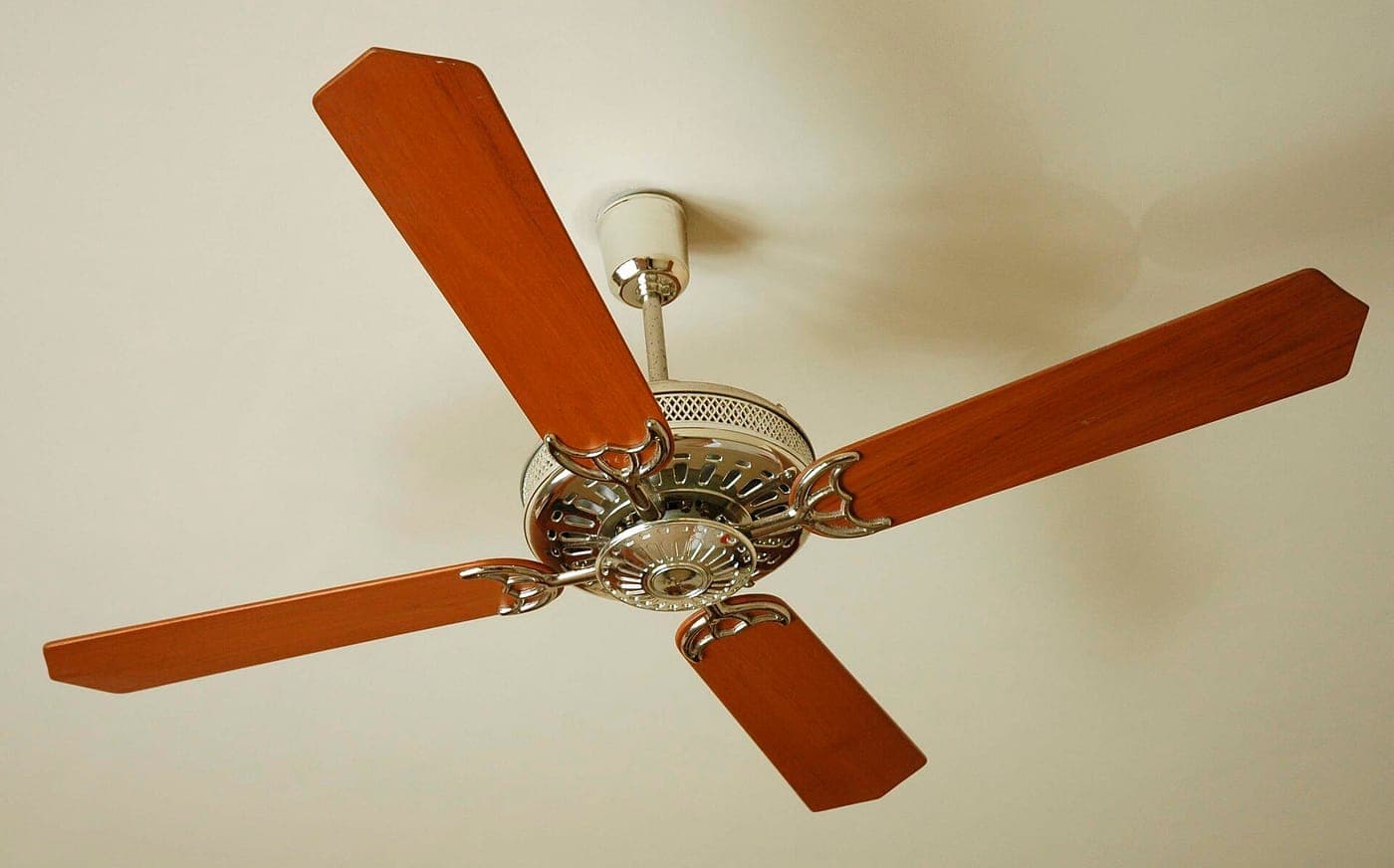
Size the fan to the room first: ENERGY STAR suggests 29-36 inches of span for rooms up to 75 square feet, 36-42 inches up to 144, 44 inches up to 225, and 50-54 inches up to 400. Under $100 you get an AC motor, pull-chain or basic remote control and an integrated LED. Quiet DC motors and app control start above this bracket.
Disclosure: we earn commission on qualifying purchases made through the links below, at no extra cost to you. It never changes the order of our picks - here is how that works.
Size the room before you look at a single fan
A ceiling fan does not cool a room. It moves air across your skin, which speeds up evaporation and makes you feel several degrees cooler at the same thermostat setting. That is the whole mechanism, and it means a fan that is too small for the room is not a slightly worse purchase - it is a fan you will run on high forever and still find disappointing.
ENERGY STAR publishes the sizing table everybody else copies, drawn from an American Lighting Association reference: 29-36 inches of blade span for a room up to 75 square feet, 36-42 inches for 76-144 square feet, 44 inches for 144-225 square feet, and 50-54 inches for 225-400 square feet. A 10 by 12 foot bedroom is 120 square feet, which puts it squarely in the 36-42 inch band. A 15 by 20 foot living room is 300 square feet and wants 50 inches or more.
The same page gives the mounting rule, and it is the one people break: mount the fan at least 7 feet above the floor and 18 inches from the walls, and 8-9 feet above the floor if the ceiling allows it. Blades at 7 feet in a room with 8-foot ceilings is the usual compromise, and it works. Blades at 6 feet 6 inches is a hazard with tall guests and a bad idea with a raised hand.
Get those two numbers right and almost any fan in this bracket will satisfy you. Get them wrong and a $400 fan will not.
- Up to 75 sq ft: 29-36 inch span. 76-144 sq ft: 36-42 inches.
- 144-225 sq ft: 44 inches. 225-400 sq ft: 50-54 inches.
- At least 7 feet of floor clearance, 18 inches from the walls.
Flush mount or downrod - the ceiling height decides, and it costs you air
A flush mount fan, also sold as a hugger or low-profile fan, bolts straight to the ceiling with no drop rod. It exists for rooms with ceilings at or under 8 feet, where a downrod would put the blades at head height. Most of the sub-$100 market is flush mount, because most of the demand is bedrooms with standard ceilings.
There is a real cost to it, and ENERGY STAR states it plainly: a hugger fan will not move as much air as a regular fan because the blades are closer to the ceiling. The blades starve for intake air from above. So a flush-mount 42-inch fan does not move what a downrod-mounted 42-inch fan moves, and if you have the ceiling height, the downrod is the better fan at the same price.
With a ceiling at 9 feet or more, buy a fan that ships with a downrod, or buy a longer rod separately - the goal is still blades at 8-9 feet. With a sloped ceiling, check the mount's maximum rated angle before you buy; most budget canopies handle a shallow slope and nothing dramatic.
What $100 buys, and what it quietly does not
Almost everything in this bracket runs an AC motor. It is the cheaper, older, perfectly functional technology: three speeds, a reverse switch on the housing, and a faint hum at the top speed that you will hear in a quiet bedroom at 2am. DC motors - quieter, with more speed steps and noticeably lower power draw - sit at the very top of this bracket and mostly above it, and they are the single clearest reason to spend more.
Controls are the other line item. Under $100 you get a pull chain or an RF remote, sometimes both. You do not get Wi-Fi, app control or a voice assistant, and the handful of cheap fans that claim it tend to do it through a brand app that may not outlive the fan. If smart control is the requirement, this is the wrong bracket.
Light kits are almost always an integrated LED panel rather than a socket you can put a bulb in. That is more efficient and lower-profile, and it means that when the LED fails in year six the fix is a new fan rather than a new bulb. Finally, warranties at this price are typically a limited one-to-several-year term rather than the lifetime motor warranty the premium brands advertise.
None of that makes a budget fan a bad buy. A correctly sized AC fan moves the same air as an expensive one; it just does it with more noise, fewer speeds and a shorter paper guarantee.
- You get: AC motor, 3 speeds, reverse switch, pull chain or RF remote, integrated LED.
- You do not get: app control, a replaceable bulb, a lifetime motor warranty.
- Noise at top speed is the price of an AC motor - size up so you can run it on medium.
Quick picks
The short version. Tap any row to jump to the full write-up, or go straight to Amazon to check the current price.
| # | Product | Best for | Price |
|---|---|---|---|
| 1 | Prominence Home Alvina 42-inch The default bedroom fan: correct span, flush mount, LED, and it leaves real money in your pocket. | Best overall under $100 | |
| 2 | Amico 42-inch low profile with light Roughly half the price of the Alvina for the same span - with the brand risk that implies. | Cheapest fan that still moves real air | |
| 3 | Hunter Low Profile 42-inch A real fan company's entry model - which means it sits right at $100 rather than under it. | Best brand-name build at the ceiling | |
| 4 | Westinghouse Contractor's Choice 52-inch A bare 52-inch fan with no light kit, which is exactly why it fits under $100. | Best for a living room or a bigger bedroom | |
| 5 | hykolity 52-inch DC motor A DC motor at the edge of the bracket - quieter and more controllable, with a single point of failure. | Best if quiet is the whole point |
We do not print prices on this site. Every button opens the live Amazon listing so you see the real price at the moment you click. See our affiliate disclosure.
1. Best overall under $100
Prominence Home Alvina 42-inch
The default bedroom fan: correct span, flush mount, LED, and it leaves real money in your pocket.
- 42 inch span
- Flush mount
- Integrated LED
- Reversible blade finishes
The Alvina is the fan to buy if you have a standard-ceiling bedroom or a small-to-medium room and no strong opinion beyond that. At 42 inches it covers the 76-144 square foot band exactly, it mounts flush for 8-foot ceilings, and it is the one model in this roundup that is comfortably under $100 at several retailers rather than only on a sale - we found it in the high-$60s to low-$80s at Walmart, Ferguson and Tractor Supply while writing this.
The blades are reversible, with a different finish on each face, which is a genuinely useful feature at this price: you can match the fan to the room without buying a different model. The integrated LED sits behind a frosted lens, so it is a soft ceiling light rather than a task light.
Prominence Home is a budget-focused ceiling fan brand rather than a general houseware label, and the Alvina has been in the catalog long enough to have a service history. Replacement remotes and blade arms are findable, which is not true of every cheap fan.
What you give up
AC motor, so it hums at top speed in a quiet room. The LED panel is integrated and not a replaceable bulb. And flush mount means it moves less air than a downrod fan of the same span - if your ceiling is 9 feet, buy a downrod model instead.
2. Cheapest fan that still moves real air
Amico 42-inch low profile with light
Roughly half the price of the Alvina for the same span - with the brand risk that implies.
- 42 inch span
- Flush mount
- Dimmable LED
- Remote control
Amico is one of the Amazon-native fan brands, and its 42-inch low-profile model is the honest answer to the question of how little you can spend and still get a working fan in a bedroom - it was listed in the mid-$40s with a four-star-plus average when we checked. The span is right for a standard bedroom and the mount is flush.
It ships with an RF remote and a dimmable integrated LED, and control sets vary by finish, so read the listing you are actually buying rather than a review of a different color. Several configurations are remote-only, which matters if you want the light on a wall switch.
Buy this one when the fan is for a guest room, a rental, a kid's room or anywhere the calculation is a working fan now rather than a fan for the next fifteen years.
What you give up
No service network and no parts channel - if the receiver module or the remote fails, the fan is consumable. Remote-only control on some variants means no wall-switch dimming. Assembly instructions are the weak point owners complain about most.
3. Best brand-name build at the ceiling
Hunter Low Profile 42-inch
A real fan company's entry model - which means it sits right at $100 rather than under it.
- 42 inch span
- Flush mount
- Pull chain on base models
- 3 speeds
Hunter has been making ceiling fans for well over a century, and its low-profile 42-inch models are where that engineering meets a budget. The motor housing is metal rather than plastic, the balance out of the box is better than the Amazon-native competition, and the blade arms do not flex when you handle them.
The catch is price discipline: Hunter's entry fans live at or just under $100 rather than well below it. Its own clearance pages listed a 42-inch model in the high-$80s to low-$110s while we were writing, and third-party retailers had the Low Profile line right at the hundred-dollar line. This is a fan you buy at the ceiling, not a bargain.
If you want the most solidly built AC fan in this roundup and you are prepared to spend the whole hundred dollars, this is it.
What you give up
Sits at the top of the bracket, so a price rise puts it out of it. The cheapest variants are pull-chain only, with no remote, and on some SKUs the light kit is a separate purchase - check what is in the box.
4. Best for a living room or a bigger bedroom
Westinghouse Contractor's Choice 52-inch
A bare 52-inch fan with no light kit, which is exactly why it fits under $100.
- 52 inch span
- 5 blades
- Downrod mount
- No light kit
A 52-inch span covers the 225-400 square foot band, which is most living rooms - and a 52-inch fan with a light kit does not fit under $100 from a known brand. Westinghouse solves that by selling the fan without one. The Contractor's Choice is a plain, five-blade, downrod-mounted fan whose job is to move air in a room that already has lighting.
We found it around $70 as an open-box listing and right at the hundred-dollar line new, which makes it the only genuine large-room option in this roundup. Because it is downrod-mounted rather than flush, it also moves more air than a hugger of the same span - ENERGY STAR's point about blades close to the ceiling cuts the other way here.
This is the fan for a room with recessed lighting, a floor lamp or an existing fixture elsewhere, where what you need from the ceiling is airflow.
What you give up
No light at all unless you buy and wire a kit, which erases the price advantage. The finish is basic and the blades are the thinner, stamped kind. And it needs a downrod and a ceiling box rated for a fan, so it is a worse fit for an 8-foot ceiling than any flush-mount model here.
5. Best if quiet is the whole point
hykolity 52-inch DC motor
A DC motor at the edge of the bracket - quieter and more controllable, with a single point of failure.
- 52 inch span
- DC motor
- ABS blades
- Remote with multiple speeds
DC motors are the real upgrade over everything else in this roundup. They draw less power for the same airflow, they offer more speed steps, and at low and medium speeds they are genuinely quieter than an AC motor - which is the difference between a fan you run overnight and a fan you switch off to sleep.
hykolity's 52-inch three-blade model is the one DC fan we could confirm as currently sold near this money, and the honest caveat is that it floats: it is inside the bracket in some finishes and over it in others, so treat $100 as the thing you are checking rather than the thing you are promised.
Pick this if the fan is going in a bedroom or a home office where noise is the complaint you are actually trying to fix.
What you give up
The DC controller module is the failure point, it is not a user-replaceable part, and a dead controller means a dead fan. The blades are ABS plastic rather than wood or metal. And the price sits at the very top of this bracket or just outside it depending on finish.
The electrical box is the hidden cost
A ceiling fan cannot hang from a standard lighting outlet box. A fan weighs several times what a light fixture weighs and it vibrates for its whole life, so it needs a box specifically listed for fan support, braced to a joist or fitted with an expanding fan brace. If your ceiling currently has a flush light fixture on a plastic pancake box, that box has to be replaced before the fan goes up.
That is the line item people forget when they compare a $70 fan to a $300 one. Changing the box is straightforward from an attic and awkward from below, and if the room has no existing ceiling fixture at all you are paying for a circuit as well as a box. Where you are not confident, an electrician for an hour is cheaper than the alternative.
The second thing to check before buying is the switch. A fan with a light on a single switched circuit either gets a pull chain for each function or an RF remote whose receiver lives in the canopy. If you want independent wall control of fan and light, you need two switched conductors at the box - and if you do not have them, the remote is doing that job whether you wanted it to or not.
- The box must be listed for ceiling fan support - a light-fixture box is not.
- Two switched conductors at the box is what gives you separate wall control of fan and light.
- A fan brace between joists is the standard retrofit when there is no access from above.
Run it the right way round, and switch it off when you leave
Every fan in this roundup has a reverse switch on the motor housing, and the manuals all say the same thing: blades turning counterclockwise as you look up push air down, which is the summer setting that makes you feel cooler. Flipping to clockwise on the lowest speed pulls air up the middle of the room and pushes the warm air that has collected at the ceiling back down the walls, which is the winter setting. In winter the goal is circulation without a draft, which is why the speed has to be low.
The economics only work if you also move the thermostat. A fan uses a fraction of the electricity an air conditioner does, but running both at the old setpoint just adds the fan's consumption to your bill. The saving comes from raising the air conditioning setpoint and letting the moving air make up the difference - and then switching the fan off when you leave the room, because a fan cools people, not spaces.
If the room's problem is actually humidity rather than heat, air movement will not fix it - that is a dehumidifier under $200 question, and humidifier vs dehumidifier explains why the two sets of symptoms get confused.
When to spend more than $100
There are four honest reasons to go up a tier. The first is a DC motor, for the noise floor and the extra speed steps. The second is a real smart platform - Wi-Fi or Matter rather than a brand-only RF remote - if the fan needs to be part of a wider setup. The third is span above 54 inches for a great room or an open plan, which simply does not exist under $100 from anybody you want to buy from. The fourth is warranty, where the premium brands offer limited lifetime motor coverage and the budget brands offer a year or two.
What you do not get by spending more is more air for the same blade span. Airflow is a function of span, pitch and speed, and a correctly sized $80 fan moves what a correctly sized $400 fan moves. The money buys quiet, control and finish.
If the fan is one line in a wider budget for the room, the rest of the home picks under $100 are grouped the same way, and the home hub collects the whole category.
How we picked
Every pick on this page is a real, currently-sold product that we could find at or under $100 at the time of the last update. Rank order is set before any link is attached.
We are research-led, not lab-led. We do not run a test lab and we do not claim to have personally used every product on this site. Picks come from manufacturer specifications, owner-reported reliability and failure patterns, expert-publication consensus, and real availability at the stated price ceiling. Read the full method.
Common questions
+What size ceiling fan do I need?
Measure the room's square footage. ENERGY STAR suggests 29-36 inches of blade span up to 75 square feet, 36-42 inches for 76-144, 44 inches for 144-225, and 50-54 inches for 225-400. A standard 10 by 12 foot bedroom is 120 square feet, so 42 inches.
+Is a flush mount fan worse than one on a downrod?
For airflow, yes. ENERGY STAR says a hugger fan will not move as much air as a regular fan because the blades sit closer to the ceiling and get less intake air. Flush mount exists for ceilings at or under 8 feet, where a downrod would put blades at head height. With 9 feet or more, use a downrod.
+Do more blades move more air?
No. Blade count is mostly an aesthetic and acoustic choice. Airflow comes from span, blade pitch and rotation speed, and three-blade and five-blade fans of the same span and motor move broadly similar air. More blades can mean marginally quieter operation and marginally more drag.
+Can I hang a ceiling fan from my existing light fixture box?
Usually not. Fans need an electrical box specifically listed for fan support, braced to a joist or fitted with a fan brace, because a fan is heavier than a light and vibrates constantly. A standard pancake or plastic lighting box is not rated for it and must be replaced first.
+Which way should a ceiling fan turn in winter?
Clockwise as you look up at it, on the lowest speed. That pulls air up through the middle of the room and returns the warm air collected at the ceiling down the walls, circulating heat without creating a draft. Counterclockwise and faster is the summer setting.
+Does a ceiling fan actually lower the room temperature?
No. It increases evaporation from your skin so you feel cooler at the same air temperature. That is why switching a fan off in an empty room saves money, and why the energy saving only materializes if you also raise the air conditioning setpoint to match.
Sources
Read next
Best space heater under $50
Best Space Heater Under $50 (October 2026)
All 1,500W heaters make the same heat. The decision is delivery method and safety cut-offs.
Best air purifier under $100
Best Air Purifier Under $100 (October 2026)
The filter is the real cost. Five purifiers under $100 ranked with three-year filter spend included.
Humidifier pick
Best Humidifier Under $100
Tank size, humidistat and hard-water behavior decide this - not mist output. Five picks under $100 and the one you should not buy.

Shop by price
Under $100
The sweet spot. The only price ceiling with real search demand in all seven categories we cover.
Category
Home
Vacuums, air purifiers, chairs and mattresses, judged on the two or three specs that actually matter.
Think we got a pick wrong, or spotted one that is out of stock or over its ceiling? Tell us - corrections go to the front of the queue.