Home - under $50
Best LED Strip Lights Under $50
Almost the entire smart light strip category sits under $50, which makes the choice about app, adhesive and color handling rather than price.
By Brijon M. - Published October 23, 2026
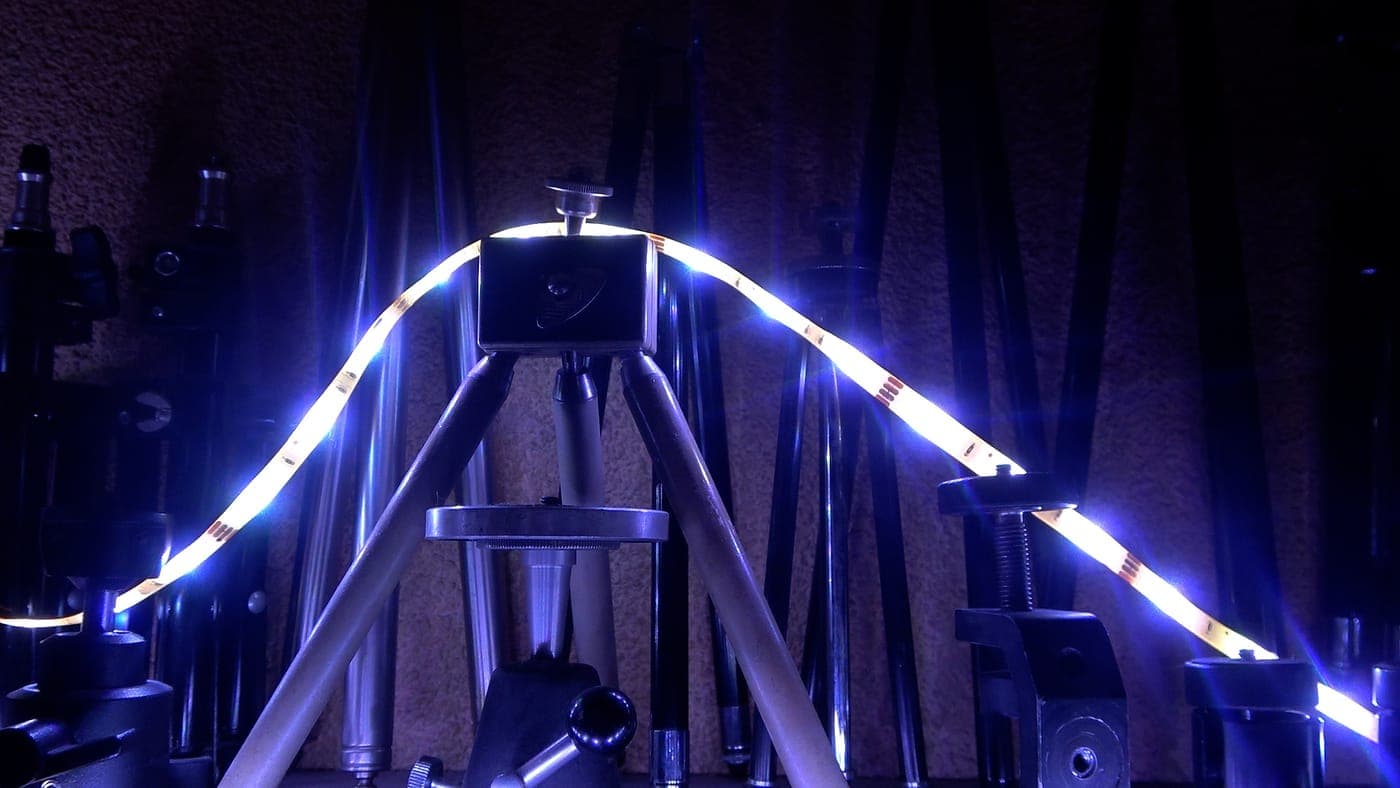
The short answer
A Govee RGBIC Wi-Fi strip is the best buy under $50 for most rooms - multiple colors along one run, a mature app, and more length per dollar than anything else. Choose the Kasa strip instead if you want the most reliable app, or the Nanoleaf Essentials Matter strip if your home runs on Apple Home or Thread.
Disclosure: we earn commission on qualifying purchases made through the links below, at no extra cost to you. It never changes the order of our picks - here is how that works.
RGB, RGBIC and white: pick the technology first
The price spread in this category is small and the specification jargon is not, so the first decision is not which brand - it is which of three fundamentally different products you are buying.
RGB. One color along the entire run. Every LED on the strip shows the same color at the same time. Cheapest, perfectly fine for a single accent color behind a headboard or a shelf.
RGBIC. The strip is divided into independently addressable zones, so several colors can run along it at once and effects can travel down the strip. This is what makes the rainbow gradients and the music-reactive chases in the marketing photos possible, and it is the main thing a few extra dollars buys.
White or tunable white. No color at all, or a range from warm to cool. This is the one you want for actual lighting rather than ambience - under kitchen cabinets, inside a closet, along a stair nose. Color strips make poor task lights because the white they produce from mixed red, green and blue renders food and skin tones badly.
Buying a color strip for a kitchen counter is the most common mistake in this category. If the job is seeing what you are chopping, the technology you want is high-CRI white, and that is a different product that we cover at the end of this page.
- Accent and ambience, one color at a time: RGB is enough.
- Gradients, effects, music sync: RGBIC.
- Task lighting under cabinets or in closets: white or tunable white, high CRI.
- Behind a TV: RGBIC, and measure the back of the TV before you buy a length.
What we judged these on
Strips fail in boringly consistent ways, and none of the failures show up on the box. These are the four things we weighted.
Does the adhesive actually hold? This is the number one owner complaint across every brand. Factory 3M tape holds on clean, smooth, room-temperature surfaces and lets go on textured paint, dusty baseboards and anything cold. The honest fix is cheap: wipe the surface with isopropyl alcohol, press for thirty seconds per foot, and buy a roll of mounting clips for the corners.
Is the app a liability? A light strip is only as reliable as the phone app and the cloud behind it, and this is where cheap strips actually differ from each other. We weighted brands with a track record of keeping the app working over brands with a brighter spec sheet.
Brightness, honestly. Manufacturers quote lumens for the whole run, which makes a long dim strip look like a bright one. A strip quoted at 2,200 lumens over 16 feet is a usable light source; one quoting a couple of hundred lumens is decoration. We say which is which below.
Can you trim and extend it? Most strips can only be cut at marked points, usually every few inches, and cutting past a copper pad kills the segment. Extendability matters more than people expect, because almost everyone underestimates the run they need.
We have not bench-tested these. Specifications below come from manufacturer and retailer listings, and the behavior notes come from published review testing, cited at the end.
Quick picks
The short version. Tap any row to jump to the full write-up, or go straight to Amazon to check the current price.
| # | Product | Best for | Price |
|---|---|---|---|
| 1 | Govee RGBIC Wi-Fi LED strip lights The most length and the most effects per dollar, from the app that does this best. | Best overall | |
| 2 | Kasa Smart LED light strip (KL420L5) 50 color zones, a PU coating and the most boring, dependable app in smart lighting. | Best app reliability | |
| 3 | Wyze Light Strip Pro 16 color zones and music sync at a price that makes a second strip an easy decision. | Best cheapest | |
| 4 | Nanoleaf Essentials Matter lightstrip The brightest strip here and the only one that speaks the standard rather than a brand's dialect. | Best for Apple Home and Matter | |
| 5 | GE Cync color-changing LED light strip with Matter Matter plus a full 2000K-7000K white range, for a house that already runs several brands. | Best for a mixed smart home |
We do not print prices on this site. Every button opens the live Amazon listing so you see the real price at the moment you click. See our affiliate disclosure.
1. Best overall
Govee RGBIC Wi-Fi LED strip lights
The most length and the most effects per dollar, from the app that does this best.
- RGBIC - multiple colors on one run
- Wi-Fi plus Bluetooth control
- Trimmable and extendable
- Works with Alexa and Google Assistant
Govee has effectively set the price of this category, and it is the brand reviewers keep naming as the overall pick because it gives you longer runs and more effects for less money than anyone else.
RGBIC is the reason to pick it. Independently addressable zones mean a single strip can show a gradient, run a chase effect down its length, or react to music per-section rather than flashing the whole run at once.
The app is the other reason. It has been iterated on for years, the effect library is enormous, and setup over Bluetooth with Wi-Fi handover is about as painless as this category gets. Alexa and Google Assistant both work.
For the standard jobs - behind a TV, along a desk, under a bed frame, around a ceiling cove - this is the default recommendation and the one that needs the least justification.
What you give up
Reviewers note the adhesive can leave residue when you pull it off, and the trim points are limited so you cannot cut it exactly where you want. There is no Matter or Thread support, it is not pretty when switched off, and like all Govee gear it wants an account and an internet connection to do its best work.
2. Best app reliability
Kasa Smart LED light strip (KL420L5)
50 color zones, a PU coating and the most boring, dependable app in smart lighting.
- 16.4 ft, 50 RGBIC color zones
- 20.5 W, rated around 25,000 hours
- PU coating, trimmable
- Works with Alexa, Google Home and SmartThings; 2-year warranty
If the thing that annoys you about smart lighting is lights that do not respond, this is the pick. TP-Link's Kasa platform is the one that gets the fewest complaints about devices dropping off the network, and the two-year warranty is double what most of this category offers.
The spec holds up against the pricier options too: 50 independently addressable color zones over 16.4 feet is finer-grained than most RGBIC strips at this price, and the PU coating makes it more tolerant of wiping down than a bare strip.
SmartThings support is the sleeper feature here - if you already run a SmartThings or Alexa routine-driven house, this slots in without another cloud account to babysit.
A rated life around 25,000 hours is roughly eight years at eight hours a day, which is longer than the app will realistically be supported - a reminder that software, not LEDs, is what ends these products.
What you give up
2.4 GHz Wi-Fi only, and no Matter or Thread, so it is a Kasa-ecosystem product rather than a neutral one. Trim points are fixed, as on every strip here, and the adhesive is ordinary - plan on clips for corners.
3. Best cheapest
Wyze Light Strip Pro
16 color zones and music sync at a price that makes a second strip an easy decision.
- 16.4 ft, 24 W
- 16 addressable color zones
- 30 LEDs per meter
- Music sync; works with Alexa and Google Assistant
Wyze built its business on undercutting everybody, and the Light Strip Pro is the most strip you can get for the least money while still having segment control and a maintained app.
Sixteen color zones is fewer than the Kasa's fifty, but it is still genuinely multi-color - enough for a gradient behind a TV or a chase along a desk, which is what most people actually use these for.
At 24 watts over 16.4 feet it is bright enough to light a wall rather than just outline it, and it is the obvious choice when you want two or three runs around a room and do not want to spend $100 doing it.
If this is your first smart light of any kind, it is also the cheapest way to find out whether you are going to use the feature at all before committing to a brand.
What you give up
Reviewers describe the strip itself as thin and flimsy compared with pricier competitors, which matters for how it handles corners and re-positioning. No Matter, no Thread, no HomeKit, and Wyze's hardware range has a mixed reliability reputation.
4. Best for Apple Home and Matter
Nanoleaf Essentials Matter lightstrip
The brightest strip here and the only one that speaks the standard rather than a brand's dialect.
- 16.4 ft, RGBW
- Around 2,200 lumens - the brightest here
- Matter support; Thread-capable line
- Trimmable and extendable
Two things set this apart. It supports Matter, so it works natively with Apple Home, Google Home, Alexa and SmartThings rather than needing a brand app to bridge it, and it is the brightest strip in this roundup by a clear margin at around 2,200 lumens.
RGBW means a dedicated white LED alongside the color ones, which produces a far more usable white than mixing red, green and blue does. If you want one strip that does party colors in the evening and plain warm light the rest of the time, this is the one that manages both.
Matter also makes it the most future-proof pick here. A strip bought into a brand's cloud is only as durable as that brand's interest in supporting it; a Matter device keeps working with whatever controller you move to.
It lands at the very top of a $50 budget, which is the honest position - this is the one to stretch to, not the value pick.
What you give up
Testers report it gets noticeably warm and that the app is confusing. Stock has been patchy at times, and at this brightness over a long run you should think about where the heat goes before enclosing it in a channel.
5. Best for a mixed smart home
GE Cync color-changing LED light strip with Matter
Matter plus a full 2000K-7000K white range, for a house that already runs several brands.
- 16 ft, 8 W
- Around 160 lumens
- White range 2000K to 7000K
- Matter over Wi-Fi and Bluetooth; Alexa, Google, Apple Home, SmartThings
The argument for this one is compatibility rather than specification. It talks Matter over both Wi-Fi and Bluetooth and is listed as working with Alexa, Google Assistant, Apple Home and SmartThings, which makes it the easiest strip here to add to a house that already has three brands in it.
The white range is also wider than most: 2000K at the warm end is proper candlelight, and 7000K at the cool end is daylight-blue, so it works as a color-temperature accent as well as a color one.
GE's lighting business has been around far longer than any of the app-first brands here, which is worth something when the risk you are managing is a brand losing interest in your product in three years.
What you give up
At roughly 160 lumens and 8 watts this is the dimmest strip in the roundup by a long way - it is strictly an accent light, not something that will light a wall. One-year warranty, and the Cync app is less polished than Govee's or Kasa's.
How to make a strip stay stuck
Adhesive failure is the single most common complaint about every LED strip ever sold, including the expensive ones, and almost all of it is preventable.
Clean the surface with isopropyl alcohol and let it dry. Factory 3M tape does not bond to dust, grease or the fine residue on painted trim. This one step fixes most failures.
Press, do not drape. Apply firm pressure along the whole run - roughly thirty seconds per foot - and give the adhesive a day before you judge it. The bond strengthens over the first 24 hours.
Textured paint and raw wood will not hold. If the surface is orange-peel drywall, brick, or anything dusty, use mounting clips or a thin aluminum channel. Clips cost a few dollars for a bag and solve the problem permanently.
Cold surfaces are a lost cause. Adhesive bonds poorly below room temperature, which is why strips in garages, basements and behind cold glass fall down first.
Corners are where it starts. The strip wants to spring back straight. Put a clip at every corner and the straight runs will usually look after themselves.
Plan for removal. If you rent, assume you will be pulling this off a painted wall. Warm the strip with a hairdryer first, peel slowly at a shallow angle, and clean residue with isopropyl alcohol rather than scraping.
If you want under-cabinet task lighting, buy something else
The top autocomplete suggestion for LED strips is under-cabinet lighting, and a color strip is the wrong product for it. Here is why, and what to buy instead.
Color rendering is the whole issue. White produced by mixing red, green and blue LEDs has gaps in its spectrum, and under it food looks gray, raw meat looks wrong and skin tones look sickly. The measurement for this is CRI, and the fix is a strip with dedicated white LEDs and a published CRI of 90 or better.
Dotting versus a continuous line. Standard strips put discrete LEDs a few centimeters apart, which under a cabinet throws a row of scallops onto the counter. COB strips, where the diodes sit under a continuous phosphor layer, produce an unbroken line of light instead. Once you have seen the difference you cannot unsee it.
What this costs. A high-CRI COB tape from a lighting brand such as Armacost runs about 16 feet on 24 volts, produces in the region of 165 lumens per foot and dims from 0 to 100 percent - but it needs a separate 24 V power supply, and the ready-to-go plug-in kits land around $60 rather than under $50.
That is above this page's ceiling and we are not going to pretend otherwise. If the job is ambience, buy one of the five picks above. If the job is seeing your countertop, spend the extra ten or twenty dollars - it is the difference between lighting and decoration.
Things nobody tells you before the first install
Measure the run before you buy, then add a third. Corners eat length, you cannot stretch a strip, and the first install almost always comes up short. Extendable strips exist for exactly this reason.
You can only cut at the marked points. Those marks are usually every few inches and cutting anywhere else severs a circuit and kills everything downstream. Measure against the cut marks, not against the wall.
Long runs get dimmer at the far end. Voltage drop is real on 12 V strips at length - the end farthest from the power supply runs noticeably dimmer. Running a second feed from the supply to the far end fixes it, and 24 V strips suffer far less from it in the first place.
The controller box has to live somewhere. Every strip has an inline control box and a power brick, and they are ugly. Plan where they go before you commit the adhesive, not after.
Check for a physical switch or a smart plug. If the app or your Wi-Fi goes down, a strip with no physical control is stuck however it was last set. Putting the power brick on a cheap smart plug gives you a hardware off switch and a schedule that works independently of the strip's own app.
IP ratings matter in bathrooms and kitchens. Most indoor strips have no meaningful water protection. If it will see steam or splash, look for an IP65 or better coating.
What we would actually buy
A first strip for a bedroom, desk or TV: the Govee RGBIC. Best effects, most length per dollar, least hassle.
You hate flaky smart devices: the Kasa KL420L5. Fifty zones, a two-year warranty and an app that stays connected.
Cheapest thing that still does gradients: the Wyze Light Strip Pro.
Apple Home, Thread or a future-proof house: the Nanoleaf Essentials Matter strip, which is also the brightest here.
A house already running three brands: the Cync strip with Matter - as long as you understand it is an accent light at 160 lumens.
LED strips are one of the cheapest upgrades in a home, and they pair well with the rest of the sub-$50 smart shelf: see best smart plug under $50 for schedules and a hardware off switch, and smart plug vs smart outlet if you are deciding how far to take it.
How we picked
Every pick on this page is a real, currently-sold product that we could find at or under $50 at the time of the last update. Rank order is set before any link is attached.
We are research-led, not lab-led. We do not run a test lab and we do not claim to have personally used every product on this site. Picks come from manufacturer specifications, owner-reported reliability and failure patterns, expert-publication consensus, and real availability at the stated price ceiling. Read the full method.
Common questions
+What are the best LED strip lights under $50?
A Govee RGBIC Wi-Fi strip for most rooms - multiple colors along one run, a mature app, and more length per dollar than the competition. The Kasa KL420L5 is the pick if app reliability matters most, and the Nanoleaf Essentials Matter strip is the one to stretch to for Apple Home, Matter support and the brightest output here.
+What is the difference between RGB and RGBIC?
RGB shows one color along the whole strip at a time. RGBIC divides the strip into independently addressable zones, so several colors can appear at once and effects can travel along its length. RGBIC is what produces the gradients and music-reactive chases in the marketing photos, and it costs only a few dollars more.
+Why do my LED strip lights keep falling down?
Almost always surface preparation. Factory 3M adhesive will not bond to dust, grease, textured paint or cold surfaces. Wipe the run with isopropyl alcohol, let it dry, press firmly for about thirty seconds per foot, and give it a day. For textured walls or corners, use mounting clips - they cost a few dollars and solve it permanently.
+Can I use LED strip lights under kitchen cabinets?
You can, but a color strip is the wrong tool. White mixed from red, green and blue LEDs renders food and skin tones badly, and spaced diodes throw scallops onto the counter. For task lighting, buy a high-CRI white or COB tape light - the ready-to-go plug-in kits run around $60, which is above this page's ceiling but worth it for a work surface.
+Can LED strip lights be cut to length?
Only at the marked cut points, which are usually every few inches. Cutting anywhere else severs the circuit and kills everything beyond the cut. Measure your run against the strip's cut marks before you peel the backing, and buy extendable if you are close to the limit - most people underestimate the length they need.
+Do LED strip lights use much electricity?
Very little. The strips here draw roughly 8 to 24 watts for a full 16-foot run, so even left on for several hours a day the running cost is small. Brightness tracks wattage closely, which is why the 8-watt strips in this roundup are accent lighting and the 24-watt ones can light a wall.
Sources
- Reviewed - best smart light strips, tested (budget pick, brightness figures, connectivity and testing notes)
- TP-Link Kasa KL420L5 retail listing (16.4 ft, 50 RGBIC zones, 20.5 W, PU coating, 2-year warranty)
- Wyze - Light Strip Pro product page (16.4 ft, 24 W, 16 color zones, 30 LEDs per meter)
- GE Lighting - Cync Direct Connect smart LED color-changing light strip with Matter (16 ft, 8 W, 2000K-7000K)
- Super Bright LEDs - Armacost RibbonFlex Pro COB LED strip (90+ CRI, 165 lm/ft, 24 V, 5 m maximum run)
Read next
Smart plug pick
Best Smart Plug Under $50
Four-packs beat single plugs, slim bodies beat fat ones, and energy monitoring is nearly free. The five worth buying under $50.
Home
Smart Plug vs Smart Outlet
The plug wins for nine buyers out of ten. The four situations where the in-wall outlet is genuinely the better purchase, itemized.
Best space heater under $50
Best Space Heater Under $50 (October 2026)
All 1,500W heaters make the same heat. The decision is delivery method and safety cut-offs.
Category
Home
Vacuums, air purifiers, chairs and mattresses, judged on the two or three specs that actually matter.

Shop by price
Under $50
The impulse tier. Some categories are genuinely solved at $50; others are a false economy, and we say which.
Think we got a pick wrong, or spotted one that is out of stock or over its ceiling? Tell us - corrections go to the front of the queue.