Pet
How Much Does an Automatic Cat Feeder Cost?
The hardware spans twenty dollars to two hundred. What separates them is not the food they dispense.
By Brijon M. - Published October 16, 2026
The short answer
A basic timed cat feeder costs about $20-$50, a programmable dry-food hopper about $40-$80, and a Wi-Fi feeder with a camera about $80-$180. Running costs are small but real: batteries, the occasional replacement bowl or gasket, and - only on camera models - an optional cloud video plan you do not have to buy.
Disclosure: we earn commission on qualifying purchases made through the links below, at no extra cost to you. It never changes the order of our picks - here is how that works.
The short version
Gravity feeder: usually under $20, once. No electronics, no running cost, no portion control.
Timed wet-food carousel: roughly $25-$50. Battery powered, holds two to five meals, needs ice packs replaced into the freezer rather than bought.
Programmable dry-food hopper: roughly $40-$80. Holds several days to two weeks of kibble, dispenses set portions on a schedule.
Wi-Fi feeder with app control: roughly $60-$120. Adds scheduling from your phone, low-food alerts and a voice recording.
Wi-Fi feeder with a camera: roughly $80-$180, and this is the only tier with an optional subscription attached.
The decision that drives cost is not how many cats you have. It is whether you feed wet or dry, because that one answer rules out most of the market immediately.
- Wet food means a chilled carousel feeder. The cheap tier is the only tier.
- Dry food opens up hoppers, Wi-Fi and cameras - and the cost range widens accordingly.
- Only camera models carry a subscription, and it is optional on every one we found.
Quick picks
The short version. Tap any row to jump to the full write-up, or go straight to Amazon to check the current price.
| # | Product | Best for | Price |
|---|---|---|---|
| 1 | Cat Mate C500 five-meal feeder Five sealed compartments, two ice packs, no electronics to fail. | Lowest cost for wet food | |
| 2 | A programmable dry-food hopper feeder Portion control and scheduling with no account and no subscription. | Best cost per feature | |
| 3 | PETLIBRO Granary Wi-Fi feeder App scheduling and a stainless bowl - and no subscription needed to use it. | Best if you travel | |
| 4 | A gravity feeder Under $20 and solves exactly one problem - the bowl being empty. | The cheapest option, honestly described |
We do not print prices on this site. Every button opens the live Amazon listing so you see the real price at the moment you click. See our affiliate disclosure.
1. Lowest cost for wet food
Cat Mate C500 five-meal feeder
Five sealed compartments, two ice packs, no electronics to fail.
- Five sealed meal compartments
- Digital timer with clock
- Two ice packs included
- Battery powered
For a wet-food cat this is close to the whole answer. Five compartments covers a weekend away or a full day of small, frequent meals for a cat on a controlled diet, and the sealed lid plus the ice-pack recess keeps food in reasonable condition for the hours that matter.
The running cost is batteries and nothing else. There is no app, no account, no firmware and no subscription, which also means there is nothing to stop working when a company changes its cloud service.
Independent pet-product testing consistently puts the Cat Mate carousel range at the top of the wet-food category for exactly this reason - it is a simple machine that does one job.
What you give up
No portion flexibility once loaded, no remote control, and wet food in a warm room is still wet food after six hours - ice packs extend the window, they do not remove it.
2. Best cost per feature
A programmable dry-food hopper feeder
Portion control and scheduling with no account and no subscription.
- 3-5 L dry food hopper
- Up to 6-8 programmable meals a day
- Portion size adjustable in small increments
- Battery backup on most models
This is the tier that solves the problem most people actually have: a cat that eats too fast, too much, or at four in the morning. Fixed portions on a fixed schedule is the mechanism, and it does not need Wi-Fi to work.
A hopper of this size holds several days to two weeks of kibble for one cat, which means the feeder is topped up weekly rather than daily and genuinely saves time.
Look specifically for battery backup and a low-food sensor. The first prevents a missed meal in a power cut; the second prevents the feeder cheerfully dispensing nothing for two days while you are away.
What you give up
Dry food only, and kibble shape matters - very large or very flat biscuits jam the auger on cheaper units. Cleaning a hopper properly means disassembly, and not every model allows it.
3. Best if you travel
PETLIBRO Granary Wi-Fi feeder
App scheduling and a stainless bowl - and no subscription needed to use it.
- 5 L hopper, up to 10 meals a day
- Dual-band Wi-Fi with app scheduling
- Stainless steel bowl
- Camera models accept a microSD card for local recording
The Granary line is the mainstream Wi-Fi feeder, and the specification that justifies the price over a dumb hopper is remote control: you can change a schedule, add a meal or check that one dispensed from anywhere.
The stainless bowl is a real durability and hygiene advantage over the plastic bowls at the tier below, and it is dishwasher safe.
On the camera versions, the cloud video plan is optional and the device records to a microSD card instead - PETLIBRO recommends a high-endurance card specifically. Taking the card route keeps this a one-off purchase.
Battery backup keeps the schedule running in a power cut, although Wi-Fi is disabled on battery to conserve it.
What you give up
Roughly double the price of a dumb hopper, and the features that justify it depend on a manufacturer app that could change or be discontinued. Minimum dispense portion is around 1/12 cup, which is coarse for a cat on a tightly controlled diet.
4. The cheapest option, honestly described
A gravity feeder
Under $20 and solves exactly one problem - the bowl being empty.
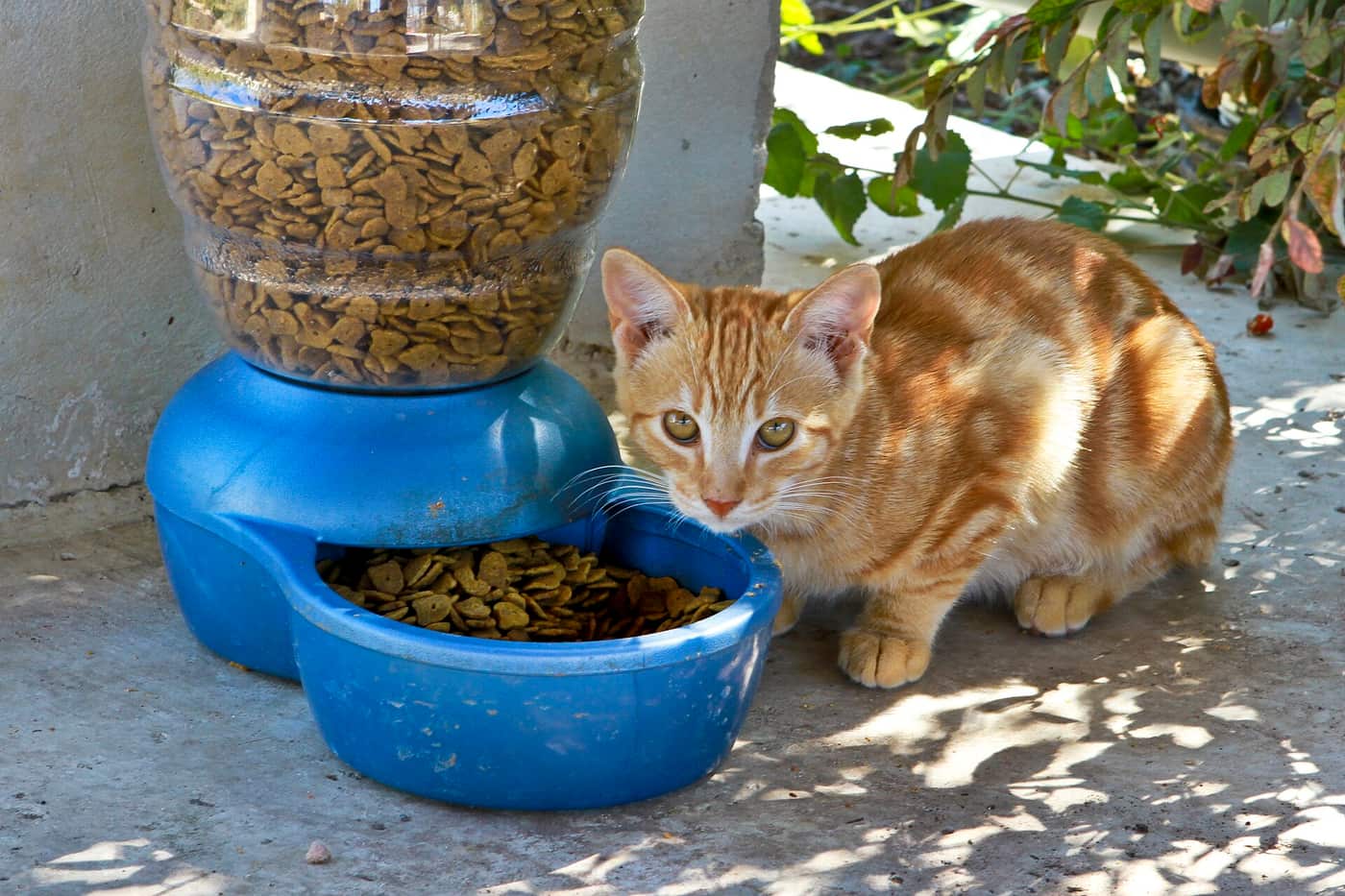
- Dry food reservoir refills the bowl by gravity
- No electronics at all
- Several days of capacity
- Usually under $20
If the only thing you want is for the bowl not to be empty when you get home late, this does that for less than the price of a bag of food, and nothing in it can break.
It is a reasonable buy for a cat that self-regulates - some genuinely do - and as a backup alongside a programmed feeder.
We list it because the honest answer to "how much does an automatic cat feeder cost" starts here, and a meaningful number of households do not need anything more.
What you give up
No portion control whatsoever, which is free-feeding by design and a poor fit for any cat with a weight problem. No schedule, no alerts, and no way to know whether the cat ate.
A worked three-year comparison
Take three realistic setups for one cat.
Setup A - timed carousel, wet food. Feeder: $45. Batteries: four D or C cells roughly twice a year, call it $10 a year. Three-year total: about $75.
Setup B - programmable dry hopper. Feeder: $60. Battery backup cells once a year, $5. One replacement bowl or gasket over three years, $12. Three-year total: about $87.
Setup C - Wi-Fi camera feeder, no cloud plan. Feeder: $100. A high-endurance microSD card: $18. Power from the mains, with battery backup cells once a year, $5. Three-year total: about $133.
Setup C with a cloud plan added at a typical few dollars a month would add roughly $150-$250 over the same period - more than the feeder cost. That is the one line in this category where the running cost can exceed the hardware, and it is entirely avoidable.
Notice how narrow the first two are. Unlike security cameras - where, as the real three-year cost of a cheap security camera sets out, subscriptions dominate the lifetime total - most automatic cat feeders are close to a one-off purchase. The spread comes from which feeder you buy, not from what it costs to keep.
Printers are the other household category where the consumable rather than the hardware sets the real price; inkjet vs laser printer for home use runs the same arithmetic there, and the gap between sticker price and lifetime cost is far wider than it is here.
What the extra money actually buys
Moving up each tier buys something specific. It is worth knowing which of these you care about before you pay for all of them.
Portion control is the jump from a gravity feeder to anything programmable, and for an overweight cat it is the single most valuable feature in this category - free-feeding is a well-known contributor to feline obesity and a gravity feeder is free-feeding by design.
Scheduling is the jump to a timed feeder, and it matters for cats on prescription diets, for early-morning wake-up behavior, and for anyone who works irregular hours.
App control buys you the ability to change the schedule or dispense an extra meal from somewhere else. If you travel, this is the feature that converts a feeder from a convenience into a genuine solution.
A camera buys confirmation. The feeder says it dispensed; the camera shows the cat ate. For a cat with a medical condition, or for a long trip, that distinction is the whole point.
Dual bowls or multiple feeders buy separation for two cats, which matters far more than most buyers expect - a fast eater will finish their portion and then take their housemate's.
The running costs people forget
Batteries. Almost every feeder in this category either runs on batteries or takes them as backup, and the backup is not optional in practice - a power cut with no battery means a missed meal. Budget a few dollars a year and, more importantly, replace them on a schedule rather than when the feeder stops.
Replacement parts. Bowls crack, silicone gaskets perish, and the rotating plate on a carousel feeder wears. These are cheap individually and they are the reason to prefer a brand that still sells spares for a three-year-old model.
Ice packs. Wet-food carousels ship with them and they go back in the freezer rather than being bought again - but they do eventually leak, and a replacement set is a few dollars.
A microSD card on a camera model, if you want recordings without a cloud plan. Buy a high-endurance card rated for continuous write; a standard card in a device that records all day fails within months.
Food waste. The least obvious cost. A hopper that dispenses inconsistently - common on very cheap models with no low-food sensor - either underfeeds or scatters kibble, and over three years that is real money and a hungry cat.
The one subscription in this category
Unlike security cameras, where a cloud plan is often the business model, automatic cat feeders are overwhelmingly sold as one-off hardware. The exception is the camera tier.
PETLIBRO's camera feeders, for example, offer an optional video cloud plan in two tiers - a shorter and a longer retention window. The company's own pre-sale documentation is explicit that the subscription is not required: the feeder and its camera work without one, and the device accepts a microSD card for local recording instead. Petlibro's documentation specifically recommends a high-endurance card, noting compatibility issues with some others.
We would take the microSD route in almost every case. The footage you actually want - did the cat eat this morning - is checked within hours, which local storage handles perfectly well. Cloud storage solves a different problem: footage surviving if the device is stolen or destroyed, which is a security-camera concern rather than a feeder one.
A warning on published figures: the subscription prices listed across manufacturer pages, app stores and regional sites for these plans are inconsistent with one another, which is why this page does not quote a specific number. Check the price inside the app before enabling a plan, and treat any figure you read elsewhere - including on the manufacturer's own marketing page - as unverified.
How to keep the cost at the bottom of the range
Match the feeder to the food, not to the feature list. If your cat eats wet food, the $25-$50 chilled carousel tier is the entire relevant market and nothing above it applies to you. Buying a $120 Wi-Fi hopper for a wet-food cat is the most expensive mistake available here.
Skip the camera unless you travel. For a feeder that sits six feet from where you sleep, the camera adds cost and a subscription prompt and solves nothing.
Buy stainless or dishwasher-safe bowls. Plastic bowls stain, hold odor and are associated with feline chin acne, and replacing them is an avoidable recurring cost.
Check that spares are sold for the model before buying. A $45 feeder you discard after two years because the bowl cracked costs more than a $60 one you keep for five.
Keep the old bowl for a few weeks. Some cats refuse a feeder outright, and a cat that stops eating is a genuine emergency rather than an inconvenience. The transition costs nothing and protects the purchase.
Our best automatic cat feeders under $50 roundup covers the bottom two tiers in detail, and are pet water fountains worth it applies the same cost arithmetic to the water side.
Common questions
+How much does an automatic cat feeder cost?
Roughly $20-$50 for a basic timed or gravity feeder, $40-$80 for a programmable dry-food hopper, and $80-$180 for a Wi-Fi feeder with a camera. Running costs are small - batteries and the occasional replacement bowl - unless you add an optional cloud video plan on a camera model.
+Do automatic cat feeders have a monthly subscription?
Most do not. Timed feeders, hoppers and plain Wi-Fi feeders are one-off purchases. Only camera-equipped feeders offer a cloud video plan, and on the models we checked it is explicitly optional - the camera works without it and records to a microSD card instead.
+Are expensive automatic cat feeders worth it?
Only for specific reasons: travel, a cat on a controlled diet, a medical condition where you need to confirm the cat actually ate, or two cats who need separating. For a cat that eats normally while you are at work, a $50 programmable hopper does the same job as a $150 one.
+What does an automatic cat feeder cost to run?
Very little. Budget a few dollars a year for batteries and roughly $10-$15 over three years for a replacement bowl or gasket. The only line that can exceed the hardware cost is an optional camera cloud plan, which you can avoid with a microSD card.
+Can you use an automatic feeder with wet food?
Yes, but only with a chilled carousel feeder that has sealed compartments and an ice-pack recess - a dry-food hopper cannot handle wet food at all. Those carousels sit in the $25-$50 bracket, so wet-food households have a narrower and cheaper market to shop.
+Do automatic feeders stop cats overeating?
A programmable one does, because it dispenses a fixed portion on a schedule. A gravity feeder does the opposite - it is free-feeding by design. If weight is the reason you are buying, portion control is the feature to pay for and the one that justifies moving up from the cheapest tier.
Sources
Read next
Best automatic cat feeder under $50
Best Automatic Cat Feeder Under $50 (October 2026)
Five automatic cat feeders under $50, split between compartment and hopper designs - what each can and cannot do, and the failure modes to test for.
Pet
Are Pet Water Fountains Worth It?
Why cats drink more from moving water, the weekly cleaning nobody mentions, and the free fixes to try first.
Best budget pet camera
Best Budget Pet Cameras (October 2026)
Local microSD storage beats cloud subscriptions. Five picks under $60 and the features that are genuinely worth it.

Shop by price
Under $50
The impulse tier. Some categories are genuinely solved at $50; others are a false economy, and we say which.
Think we got a pick wrong, or spotted one that is out of stock or over its ceiling? Tell us - corrections go to the front of the queue.