Pet - under $100
Best Cat Litter Box Under $100 (October 2026)
The single most common litter box problem is that the box is too small, and it costs nothing to fix.
By Brijon M. - Published October 2, 2026
The short answer
The best litter box under $100 is a large, open, high-sided plain plastic box - ideally one and a half times your cat's length. Size and cleanability matter more than any feature, and a cheap self-cleaning box is the one purchase in this category we would actively steer you away from.
Disclosure: we earn commission on qualifying purchases made through the links below, at no extra cost to you. It never changes the order of our picks - here is how that works.
The size rule, which solves most problems
The guidance most commonly given by veterinary behavior sources is that a litter box should be about one and a half times the length of the cat, measured nose to base of tail. Most boxes sold in pet shops are considerably smaller than that for an average adult cat.
A cat needs room to turn around, dig, position itself and cover afterwards without touching the sides. A box that is too small produces exactly the behaviors owners complain about: eliminating over the edge, refusing the box, or going elsewhere entirely.
The practical consequence is one of the better value hacks in pet ownership: a plain under-bed storage tub makes an excellent litter box, is far larger than most purpose-made boxes, and costs a fraction. If the sides are too tall for an older cat, cut a U-shaped entrance in one end and sand the edge smooth.
The other number that matters: one box per cat, plus one. Two cats need three boxes, in different locations. This is the second most common cause of litter box problems after size.
Open or hooded?
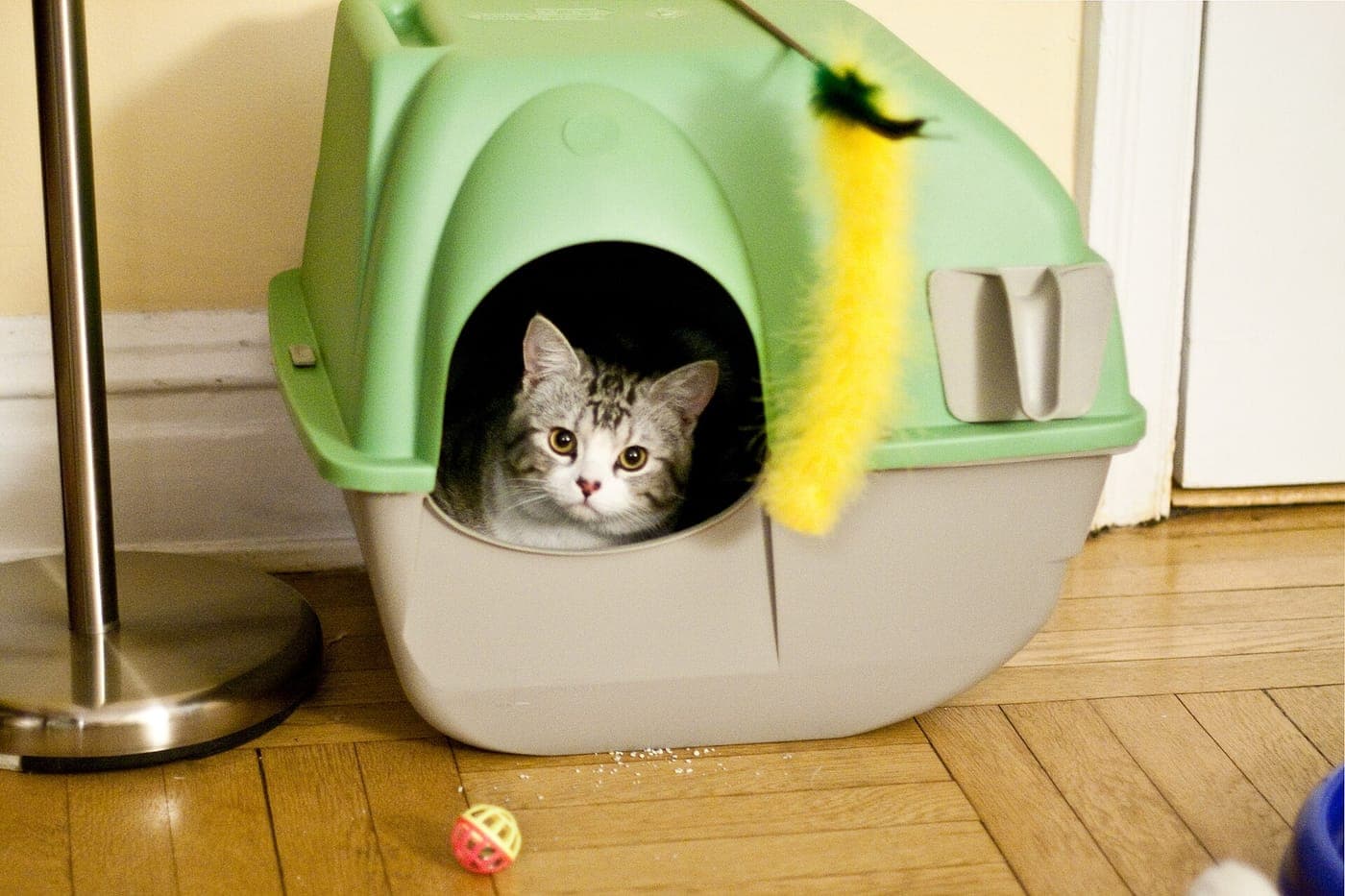
Hooded boxes are popular with owners for obvious reasons - they contain smell and hide the contents. Cats are frequently less enthusiastic.
The case against hoods: they trap odor inside, where the cat is, which is unpleasant for an animal with a far better sense of smell than yours. They restrict escape routes, which matters to a cat that is wary of being cornered - particularly in a multi-cat household. And they make it easy for an owner to not notice the box needs cleaning, because they cannot see it.
The case for: they contain litter scatter, which is a real benefit, and some cats genuinely prefer the privacy.
Our default recommendation is open and large, with high sides to contain scatter rather than a hood. If your cat has used a hooded box happily for years, there is no reason to change it - but if you are having problems, removing the hood is a free experiment worth running.
- 1.5x your cat's length. Most boxes sold are too small.
- One per cat plus one, in separate locations.
- Open with high sides beats hooded for most cats.
Quick picks
The short version. Tap any row to jump to the full write-up, or go straight to Amazon to check the current price.
| # | Product | Best for | Price |
|---|---|---|---|
| 1 | Extra-large open litter box Bigger, open, high-sided. Everything a litter box needs to be. | Best overall | |
| 2 | Plastic under-bed storage tub A bigger box than any pet brand sells, for a fraction of the price. | Best value, by a wide margin | |
| 3 | Top-entry litter box Solves tracking and keeps dogs out, if your cat accepts it. | Best for litter scatter and curious dogs | |
| 4 | Litter-catching mat The cheapest fix for the thing people complain about most. | The accessory that actually matters | |
| 5 | Metal litter scoop A few dollars for something that does not break or warp. | Replaces the one that snapped |
We do not print prices on this site. Every button opens the live Amazon listing so you see the real price at the moment you click. See our affiliate disclosure.
1. Best overall
Extra-large open litter box
Bigger, open, high-sided. Everything a litter box needs to be.
- Extra-large footprint
- High sides, open top
- Smooth plastic
- Low cost
The right answer for most households and almost the cheapest thing on this page. A large open pan with high sides gives the cat room to turn and dig, contains scatter, and is trivial to scoop and wash.
Buy the largest one that fits the space. In this category the usual advice to not over-buy is reversed - bigger is simply better, up to the limits of your floor.
Smooth plastic matters: textured or scratched plastic holds odor and is harder to clean properly, which is why boxes should be replaced every year or two regardless of price.
What you give up
No odor containment at all, so placement matters, and litter scatter still happens with an open top.
2. Best value, by a wide margin
Plastic under-bed storage tub
A bigger box than any pet brand sells, for a fraction of the price.
- Very large footprint
- High sides
- Smooth plastic
- Often under $20
This is the genuine value pick and it is not a pet product. An under-bed storage tub is longer, wider and deeper than almost any purpose-made litter box, costs a fraction, and is made of exactly the same smooth plastic.
For a large cat, a messy digger, or a cat that pees over the edge of a normal box, the high sides solve the problem immediately.
If your cat is elderly or arthritic, cut a U-shaped entrance in one short end and sand the cut edge smooth - it takes ten minutes.
What you give up
Unmodified, the high sides are a genuine obstacle for kittens and older cats, and it is a plain box with no odor control whatsoever.
3. Best for litter scatter and curious dogs
Top-entry litter box
Solves tracking and keeps dogs out, if your cat accepts it.
- Entry hole in the lid
- Grooved lid catches litter
- Contains scatter well
- Dog-resistant
A box the cat enters from above through a hole in the lid. Two genuine advantages: the grooved lid catches litter off the cat's paws so tracking drops sharply, and dogs cannot get into it - which is a real problem in mixed households that owners are often too polite to mention.
The caveat is acceptance. Some cats take to it immediately and some will not use it at all, and that is not predictable in advance.
Unsuitable for kittens, elderly cats and anything with joint problems, all of which need a low step-in entrance.
What you give up
Not all cats will use one, and it is unsuitable for kittens or any cat with mobility issues. Scooping through the lid opening is more awkward.
4. The accessory that actually matters
Litter-catching mat
The cheapest fix for the thing people complain about most.
- Honeycomb or ridged surface
- Catches litter from paws
- Washable
- Under $25
Tracking - litter carried out of the box on paws and distributed across the house - is the single most common day-to-day complaint about litter boxes, and a good mat is far more effective at solving it than any box design.
The two-layer honeycomb mats work best: litter falls through the top surface and is trapped between the layers, and you tip it out when it fills.
A large mat outperforms a small one, because cats take several steps before the litter is off their paws. Put it so the cat has to walk the length of it.
What you give up
Needs emptying and washing regularly or it becomes a litter reservoir, and some cats dislike the texture underfoot at first.
5. Replaces the one that snapped
Metal litter scoop
A few dollars for something that does not break or warp.
- Aluminum or steel
- Deep blade
- Narrow slots for clumping litter
- Under $20
Unglamorous and worth the small amount it costs. Plastic scoops flex, warp against clumps stuck to the base, and snap - usually at the worst possible moment.
A metal scoop with a deep blade and narrow slots handles clumping litter cleanly and will outlast several boxes.
Daily scooping is the thing that actually controls odor, far more than any box feature, and a scoop you do not resent using is a small part of making that happen.
What you give up
Heavier than plastic and the metal edge can scratch a cheap plastic box base over time.
The case against cheap self-cleaning boxes
Automatic litter boxes are the obvious thing to want and the one purchase in this category we would steer you away from at this price.
Cheap mechanisms jam. A rake or rotating drum driven by an underpowered motor stalls on a large clump or on litter stuck to the base, and a jammed self-cleaning box is dirtier than a manual one because nobody is watching it.
Many cats refuse them. The motor noise and the movement are genuinely off-putting to a significant number of cats, and a cat that will not use its box finds somewhere else.
They hide the evidence. This is the one that matters most and gets mentioned least. Litter box output is one of the main ways owners notice early illness - changes in urine volume are an early indicator of kidney disease and diabetes, both common in older cats. A box that disposes of everything automatically removes that signal.
The good ones cost several times this budget, and even those require proprietary litter or disposal cartridges with an ongoing cost.
If scooping is genuinely the barrier, a larger box with better litter makes it a thirty-second job rather than removing it entirely.
Litter matters more than the box
Most research on cat litter preference points the same way: cats generally prefer fine-grained, unscented clumping litter - the texture closest to sand, which is what they would use outdoors.
Unscented. Perfumed litter is designed for the human nose and cats frequently dislike it. If your cat is avoiding the box, scented litter is one of the first things to change.
Depth of about 2-3 inches. Enough to dig and cover properly. Too shallow and they cannot bury; too deep and some cats dislike the instability.
Change litter brand gradually if at all. Cats form strong substrate preferences and an abrupt change is a documented cause of box avoidance.
Litter is also the larger long-run expense. The box is a one-off; litter is monthly, which is worth remembering when comparing a $25 box to a $90 one.
When a litter problem is a vet problem
Important enough to state plainly. A cat that suddenly stops using a box it has always used is often telling you something medical rather than behavioral.
Straining, frequent small urinations, crying in the box, blood, or going just outside the box are all signs that warrant a vet visit rather than a new box. Urinary blockage in male cats is a genuine emergency and can be fatal within a day.
Buy the bigger box, use unscented clumping litter, add one more box than you have cats - and if the problem started suddenly in a cat that was previously fine, call the vet first.
How we picked
Every pick on this page is a real, currently-sold product that we could find at or under $100 at the time of the last update. Rank order is set before any link is attached.
We are research-led, not lab-led. We do not run a test lab and we do not claim to have personally used every product on this site. Picks come from manufacturer specifications, owner-reported reliability and failure patterns, expert-publication consensus, and real availability at the stated price ceiling. Read the full method.
Common questions
+What size litter box does my cat need?
About one and a half times your cat's length from nose to base of tail. Most boxes sold are smaller than that for an average adult cat, and a box that is too small is the most common cause of litter box problems.
+How many litter boxes do I need?
One per cat plus one, placed in different locations. Two cats means three boxes. This is the second most common cause of problems after box size, and it is cheap to fix.
+Are covered litter boxes bad?
Not inherently, but they trap odor where the cat is, restrict escape routes, and make it easier for owners to neglect cleaning. An open box with high sides is the better default, and removing a hood is a free experiment if you are having problems.
+Are cheap self-cleaning litter boxes worth it?
We would avoid them at this price. Cheap mechanisms jam, many cats refuse them, and they remove one of the main ways owners spot early illness - changes in urine output are an early sign of kidney disease and diabetes.
+What litter should I use?
Fine-grained unscented clumping litter, at a depth of about two to three inches. Cats generally prefer the texture closest to sand, and perfumed litter is designed for people rather than cats. Change brands gradually if at all.
Sources
Read next

Best pet hair vacuum under $200
Best Pet Hair Vacuum Under $200 (October 2026)
Tangle-resistant brush roll beats raw suction. Five picks under $200 and the filtration that matters for allergies.

Pet
Are Pet Water Fountains Worth It?
Why cats drink more from moving water, the weekly cleaning nobody mentions, and the free fixes to try first.

Shop by price
Under $100
The sweet spot. The only price ceiling with real search demand in all seven categories we cover.
Think we got a pick wrong, or spotted one that is out of stock or over its ceiling? Tell us - corrections go to the front of the queue.